






Categories
- Raw Wood Veneer
- Paper-Backed Veneer
- Edge Banding
- Vacuum Press Items
- Veneering Supplies
Shop by
Veneer Species
Build Your Own Vacuum Press

Veneer Supplies Newsletter



Wood Veneer Adhesive Guide
Here is a brief look at the many types of glue available for working with veneer.
Our PDF quick-info chart can be found at this link.
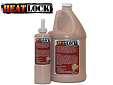 Iron-On Veneer Glue is easy, convenient, and inexpensive. This glue is applied to the substrate and the veneer back and allowed to dry. The veneer is then placed on top of the project panel and heated with a clothes iron. Heat Lock™ is excellent for this and especially suitable for small, curved, or oddly shaped pieces. Click here to learn more. To get a perfect grain and color match, some woodworkers use it to make custom edge banding from strips of the veneer used on the face of the panel. This adhesive is not a replacement for a vacuum press; it's a complement to it.
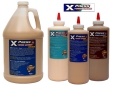 Cold Press Glue such as Better Bond X-Press™ is typically much thicker than yellow glue, which means less bleed-through and a more durable bond. Yellow glues typically do not cure with a rigid glue line. X-Press veneer glue dries to a hard film that does not allow as much "creep" or movement of the veneers on the substrate.
X-Press veneer glue is available in 3 wood colors (light, medium, and extra dark). The benefit of tinted veneer glue is a less conspicuous glue line and a reduction in the after-effect of sanding the veneer too much. It is also great for filling voids in burl veneers. If you're not doing a lot of veneer work and just need general-purpose veneer glue, go with the medium-tone version.
Keep in mind that X-Press is not suitable for use on crotch grain or extra-thick wood veneers. Consider a PPR glue for those types of uses.
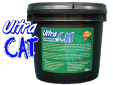 Pre-Catalized Powdered Resin (PPR) Glues are suitable for cold and hot pressing. The choice between a PPR adhesive and standard cold press glues is largely based on where the veneered panel will be used. PPR glues such as Ultra-CAT™ are type II heat and water-resistant. This type of glue is also ideal for bent laminations, crotch grain veneer, and thick veneers because it cures rock-hard.
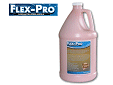 FSV Adhesive such as Flex-Pro™ is a good adhesive for paper-backed veneers when a vacuum press and a cold press veneer glue cannot be used. This type of adhesive is not suitable for unbacked wood veneer.
It's applied in a manner similar to contact cement and has a very high initial tack. It dries harder than yellow glue but not as hard as cold-press veneer glue. Generally speaking, it should only be used on porous substrates. It is also an excellent adhesive for those who prefer the traditional hammer veneering method.
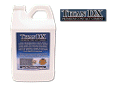 Contact Cement is available in two versions. One is solvent-based and is highly flammable. It also emits dangerous fumes that can linger in the shop for days.
Thanks to advances in adhesive polymers, there are now water-based contact cements that are non-toxic and work as well as or better than the solvent-based type. For several years, water-based contact adhesives were considered inferior to the solvent-based cements, but this has changed dramatically with the introduction of a new breed of water-based contact cement such as Titan DX™.
Keep in mind that contact cement is only suitable for use with paper-backed and wood-backed veneers.
Epoxy can be used in veneer work, but it's expensive, messy, requires mixing, and has a short life once it's mixed. Epoxy is typically used where ordinary veneer glue will not adhere (plastics, metal, etc).
It's also an effective grain filler for any veneer that will not be stained or dyed. Use a plastic spreader and apply just a little more hardener to the epoxy than what is normally used. Once cured, hand sand the panel with 150 grit paper and finish with your favorite top coat.
Polyurethane Glue bonds to almost anything. It is suitable for veneering when the veneer has to be pressed to a non-porous surface such as plastic. However, it may be best to use this glue only on small panels because it is difficult to spread, and it bleeds through more than most adhesives due to the foaming action. It's also expensive.
Yellow glue (PVA) is probably the first glue that comes to mind when you say "glue" to a woodworker. Despite the recommendations of many online woodworking sites, yellow glue is not suitable for veneering. This type of glue never fully hardens and thus allows the veneer to "creep" or move during seasonal changes in humidity. And because of its thin consistency, yellow glue also has a tendency to bleed through and discolor the veneer. Lastly, it is also very difficult to sand since yellow glue dries with a soft glue line.
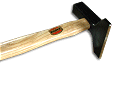 Hide Glue is the most traditional veneering adhesive. Its use dates back over 4,000 years ago to Egyptians, who used it on furniture for the pharaohs. The method is called hammer veneering, which derives its name from the use of a tool called a veneer hammer. The hammer is used to press the veneer sheets onto the substrate.
The method also requires a means of heating the glue, typically in a "double boiler." Hide glue is very durable, and it can be re-heated and reactivated if bubbling occurs. Hide glue cannot be used in a vacuum press unless the appropriate salt or urea is added. Hammer veneering can also be done with FSV glue.
Veneer Glue Comparison:
| Glue | Pro's | Con's | Comments |
| Better Bond™ X-Press Veneer Glue |
- Fast drying (1 hour) |
- Will not withstand extended periods of moisture or heat - Not suitable for use with shop-sawn veneer (use Ultra-CAT instead) |
We prefer this glue over all others. It consistently yields excellent results. |
|
Ultra-CAT™ |
- Withstands heat/moisture |
- Requires mixing |
This glue can be "thermo-set" with the use of a heating blanket over the vacuum bag which makes the bond even stronger. Ideal for shop-sawn veneers. |
|
Flex-Pro™ |
- Bonds backed veneer |
- Expensive |
Ideal for backed veneers. If you have a vacuum press, use cold press veneer glue instead. |
|
Heat Lock™ |
- Easy to work with |
- Expensive compared to regular veneer glue |
This glue definitely has its uses. Makes veneering a curved drawer front a snap! |
| Solvent-Based Contact Cement |
- Easy to find |
- Highly Flammable |
We do not recommend this type of adhesive in because of the odor and toxicity. |
| Titan DX™ Water-Based Contact Cement |
- Non-flammable |
- Does not allow repositioning |
For backed veneers, this is stuff is great. Water-based contact cement has really advanced in the last few years. |
Glue Terminology:
-
Clamp or Set Time - The amount of time the veneered panel will need to be pressed.
- Flash Time - The amount of time you need to wait before setting the veneer onto the glued substrate. For standard cold press veneer glue, this term is not used because the veneer can be placed onto the panel immediately after the glue is applied.
- Shelf Life - The length of time that a product can sit unused and unopened.
-
Open Time - The amount of time between when you apply the glue and when the material is placed in the press.
-
Cure Time - The amount of time that it takes for the glue to fully harden (usually outside the press).
- Pot Life - The length of time in which a glue can be used after it is mixed. In the list above, only the PPR glue requires mixing.
Got a question about veneer glue?
Be sure to see this Frequently Asked Questions page for more information.
 |
|
 |
|||||||||||||||||||||||||||||||||


All Content ©2026 VeneerSupplies.com™
Terms and Conditions | Privacy Policy | Contact Us