





Categories
- Raw Wood Veneer
- Paper-Backed Veneer
- Edge Banding
- Vacuum Press Items
- Veneering Supplies
Shop by
Veneer Species
Build Your Own Vacuum Press

Veneer Supplies Newsletter



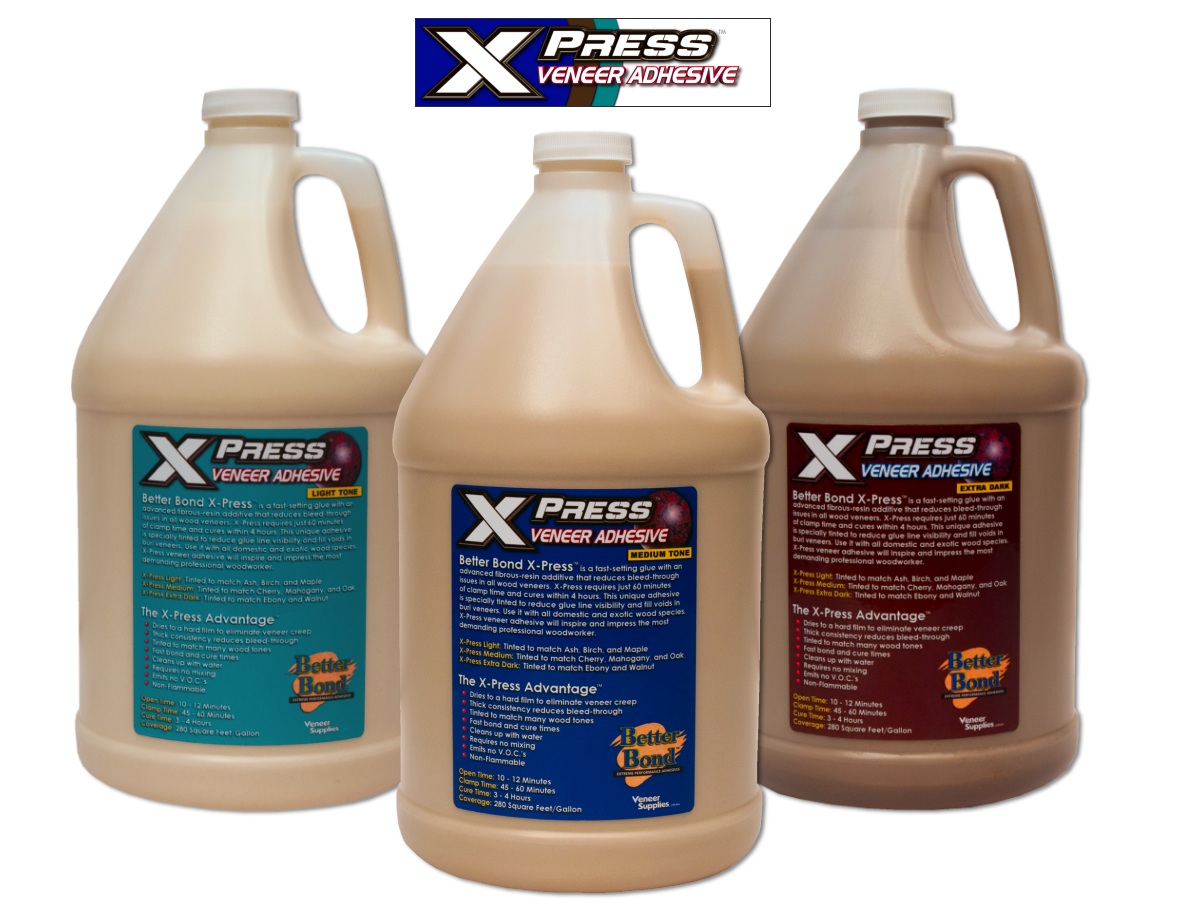
Better Bond X-Press™ Veneer Glue





Better Bond X-Press™ is a fast-setting veneer glue with an advanced fibrous-resin additive that reduces bleed-through issues in all wood veneers. This unique adhesive is specially tinted to reduce glue line visibility and fill voids in burl veneers. It is suitable for use with most standard-thickness domestic and exotic wood species.
We call it X-Press ("express") because it sets very fast - only 45 to 60 minutes of clamping time is needed, and it does this without sacrificing usability or ease of application.
Months of testing and valuable customer feedback allowed me to fine tune the synthetic fibrous-resin additive that is blended into every batch. This component minimizes bleed-through issues and acts as a gap-filler for voids in burl veneers. Don't be fooled by adhesives that claim ridiculously high levels of solids. The solid content percentage indicates nothing about bond strength, and so it is often over-estimated for marketing purposes.
Better Bond X-Press™ veneer glue is formulated for vacuum pressing but will also work with many other veneer clamping methods.
The importance of applying this glue correctly cannot be overstated:
- We've seen several AI generated "tips" that are very misleading (or completely wrong) that will lead to bad veneering outcomes. Do not ignore the directions on the adhesive bottle, as these are the best instructions to use. You can also find the adhesive instructions at the bottom of this page.
 Don't make the mistake of using a paint brush or paint roller to apply this adhesive. A dedicated glue roller is the recommended application tool. This suggestion is not a sales tactic! The glue roller we offer is unmistakably the right tool to apply this adhesive.
- Countless online videos (from sources unrelated to our website) contain surprisingly false information about using Better Bond adhesive products. Exercise caution if you plan to follow any application tips that are not aligned with the instructions on the bottle.
Features
 Non-flammable
- No mixing required
- No harmful V.O.C.'s
- Cleans up with water
- Heat resistance to 180°F
- Fast bond and cure times
- Thick consistency reduces bleed-through
- Dries to a hard film that eliminates veneer creep
- Tinted to inconspicuously fill voids in burl veneers and hide the glue line
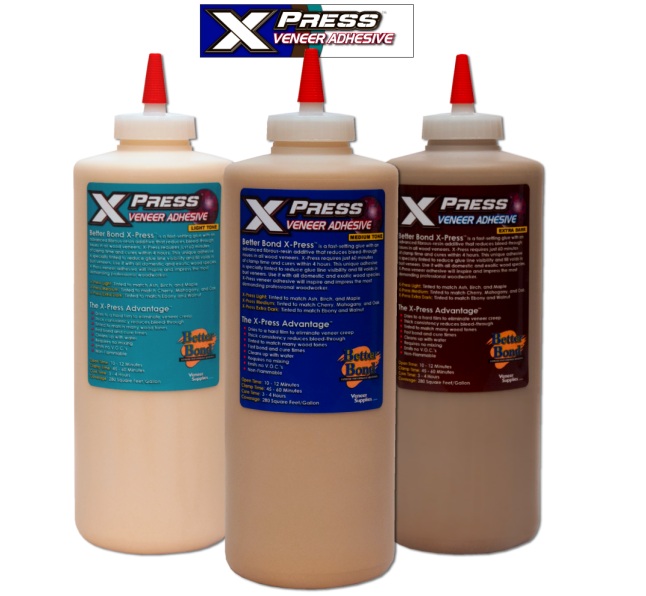
Available Sizes: Quart: $18.95 Gallon: $37.95
Shelf Life: 12 months *
Assembly Time: 10 - 12 minutes *
Clamp Time: 45 - 60 minutes
Coverage: 70 square feet per quart, 280 square feet per gallon *
Minimum Use Temperature: 60° F
Freeze/Thaw Stable: Yes
Safety Information: Click here
* approximately
Tone Options
Light: Dense buttery tone typically matches Ash, Birch, and Maple
Medium: Brown tone with a hint of red typically matches Cherry, Mahogany, and Oak
Extra Dark: Dark chocolate tone typically matches Walnut and Wenge

Tips from Joe
- X-Press glue has a fairly high spread rate and because of this, we've found that customers often apply it too thick. A dedicated glue roller can help with this. This suggestion is not a sales tactic! The glue roller we offer is unmistakably the right tool to apply this adhesive.
- For veneer work, X-Press glue is only applied to the substrate. Do not apply this glue to the veneer.
- This adhesive is not suitable for crotch grain veneers, extra-thick veneers, or multi-layer laminations. PPR glue such as Ultra-CAT™ is a better option for these types of uses.
- Like all water-based adhesives, X-Press is only suitable for use on porous surfaces such as MDF, particle board, and plywood.
- You want a durable veneered panel, right? Then don't use yellow glue or the equivalent for veneering. It's a common mistake, and yet many will tell you about their success using yellow glue on veneer. The problem is they often do not have long term success. Yellow glue allows veneer to expand and contract with seasonal changes in humidity, even when a top coat is applied. This is called "veneer creep" and it will eventually cause the veneer to delaminate.
- X-Press is also an excellent general-purpose woodworking glue.
- Use 80 grit sandpaper to thoroughly scuff sand the substrate surface. This will create the best possible bond strength. All water-based adhesives require a porous substrate surface. Do not use on non-porous surfaces.
- Closed-pore veneers should be scuff-sanded on the side that will contact the adhesive. Certain species such as maple will require considerably more clamping pressure than others. If this adhesive is used with a paper-backed veneer, thoroughly scuff the backing with 80 grit sandpaper before application to allow adequate penetration.
- Apply X-Press glue to the substrate material only. The correct amount of adhesive has likely been applied if a pencil line drawn on the substrate is easily visible through the glue layer. Ripples will form in the veneer if too much adhesive is applied.
- Veneer panels have a tendency to warp when removed from the press. A "balance" veneer should be used on the back side of the substrate to minimize warping. This will balance the stress placed on the substrate as the glue dries. Allow both sides of the panel to dry evenly by supporting the panel with dowels until the glue has cured on both sides.
- Do not use below 60° F.
- Clamp the panel for no less than 45 minutes and no more than 60 minutes. Full curing occurs outside the vacuum bag or clamping mechanism within 3 to 4 hours.
Questions About Veneer Glue?
Check out the JoeWoodworker Veneer Glue FAQ.
Questions & Answers
Please Note
In addition to the questions and answers shown below, you'll find a lot of other helpful information on the Joe Woodworker Veneer Glue FAQ page.
Which tone should I use for a veneer with both light and dark colors?
Generally speaking, it's best to choose a darker tone when the veneer contains both light and dark colors. When working with a burl veneer, consider using a tone that matches the color of the wood cells around the voids, which are often somewhat darker than the rest of the veneer. Some species have a very light color for much of the surface area but have very dark burl pockets. It's best to use the medium or extra dark tone of the cold press glue for these types of veneers.
Do I apply the glue to the back of the veneer and to the project surface?
X-Press glue should only be applied to the project surface. Do not apply it to the back of the veneer.
Is this adhesive freeze/thaw stable?
Freezing will not harm this product.
What is the best way to apply this adhesive?
We offer a very affordable (and reusable) glue roller that is ideal for applying X-Press glue.
Do you have a size smaller than a quart?
I only have the sizes listed on product page. The quart is the smallest I offer, since there is very little cost savings if we offered a pint size.
Do you have a size larger than a gallon?
I only have the sizes listed on product page. A five-gallon bucket would cost the same as five individual gallons, and it would be incredibly expensive to ship.
Can this adhesive be used for general purpose woodworking?
Yes. This glue is excellent for standard glue joints, especially since the glue line will have a wood tone.
Can I thin this adhesive with water?
X-Press veneer glue can be thinned up to 5% by volume to make it easier to spread. Thinning should not be required if you are using the glue roller we offer. Be aware that thinning this adhesive can increase the chance of bleed-through. Lastly, I recommend against thinning X-Press when it will be used with maple veneer.
Why would I get less coverage per bottle than what it shows on the label?
It is very common for new X-Press users to apply way too much glue to the substrate. A quart of X-Press will cover approximately 70 square feet of substrate surface. This is approximately 2.2 square feet per ounce of adhesive when applied correctly.
What can I do to extend the open time of this X-Press?
Better Bond X-Press™ veneer glue has an open time of 10 to 12 minutes. For larger projects, this means you need to work quickly to get the project into the bag. But there are easy ways to increase the open time to as much as 20 minutes.
You can lengthen the open time by "priming" the substrate with a 60/40 mixture of water and cold press veneer glue. Brush or roll this on to the substrate and let it dry. The primer coat will seal the pores of the substrate, so the water from the glue is not pulled out. Be sure to thoroughly scuff sand the surface with 60 grit sand paper after the glue has dried. This can add 5 to 8 minutes to the open time without affecting the adhesion. You can then proceed to apply glue to the substrate as you would to adhere the veneer to the substrate.
You can get even more open time by lowering the temperature in the shop. For some, this means turning down the heat. For others, it means turning up the air conditioning or working in the evening when shop temperatures are lowest. Cooler temperatures slow down the setting of the glue. Don't go below 60° F as that will not allow the glue to cure.
Can I use this glue on paper-backed veneer?
Yes. Thoroughly scuff the back side of the veneer before application to allow adequate penetration of the adhesive.
Is this glue thicker than other water-based veneer adhesives?
Most of the water-based veneer adhesives appear to be roughly 4,500 centipoise. X-Press adhesives is considerably thicker at approximately 13,500 centipoise. Thinner glues have a tendency to bleed through into the face of the veneer, which typically ruins the project. We've been able to increase centipoise without reducing the strength of the bond.
What the heck is centipoise?
It is a unit of measurement for viscosity. Take a look at this page for more information.
Will this glue work for bent laminations?
For any type of multi-layer veneering, it is best to use a PPR glue such as Ultra-CAT.
What is the shelf life of this adhesive?
Our supplier specifies 15 months of shelf life. Since our inventory turn-over rate is just under 3 months, our customers can expect 12 months of shelf life. Refrigerating this adhesive does not extend this time.
Can I use this glue even if it is beyond the shelf life?
That is a risk that you have to be willing to take. I would not recommend it, and I would not use an expired adhesive for my own veneer projects. Typically, there are no indicators that a glue has exceeded the shelf life and is not suitable for use.
What filler can I use if my project surface has gouges in it?
Wood fillers typically create a non-porous surface. The problem is that water-based adhesives do not bond very well to non-porous surfaces. However, when the damaged area is minimal, I use the X-Press glue as a filler. It takes longer to harden than conventional wood filler, but once it dries, it is rock-hard and easy to sand flush with the panel surface. I've also had success filling small areas with both Bondo and with Elmer's "Stainable" wood filler. On larger gouges, I've had success with Durham's Rock Hard Water Putty. Be sure to scuff sand the filled areas with 60 or 80 grit paper to get maximum bond strength.
What kind of finishes can be used on a project that has been veneered using this adhesive?
You can use shellac as well as water-based, oil-based, lacquer-based, and alkyd-based stains and top coats. Do not flood the surface with the first coat of finish. Apply a light coat and allow it to dry. Then proceed with heavier coats of finish as needed.
Is this glue suitable for thick veneers?
The current norm for veneer thickness is 1/42". Better Bond X-Press adhesive is perfect for this thickness and any veneer up to 1/32". For thicker veneer, a PPR glue such as Ultra-CAT is recommended. Here's why... All wood veneers expand and contract with seasonal changes in humidity. A thick veneer has a greater ability to expand and contract with seasonal humidity changes. Problems can arise when the veneer expands and contracts more than the substrate, and this can lead to "veneer creep". It is avoided by using an exceptionally strong glue to bond the veneer to the substrate. A PPR glue like Ultra-CAT is more than strong enough to prevent creeping of thicker veneers.
Can I use this adhesive on crotch grain veneer?
Better Bond X-Press veneer glue is not recommended for crotch veneers. A plastic powdered resin glue such as Ultra-CAT™ is far better for challenging veneers with crotch grain.
Where can I find a chart that shows all of the Better Bond veneer glue differences?
This downloadable adhesive chart shows all key points about each of the Better Bond veneer adhesives and may be helpful when choosing a glue for your next veneering project.
What else should I know about this glue?
The importance of applying this glue correctly can not be overstated. Don't make the mistake of using a paint brush or paint roller. Our reusable glue roller is the recommended tool for applying this adhesive. A good test is to draw pencil lines on the substrate and then apply the glue. Be sure to cover the entire substrate surface evenly. If you can readily see the pencil marks on the substrate (through the adhesive), you probably have the right amount of glue. If you can't see the pencil line at all, then you might have applied twice as much glue as necessary.
Always use 80 grit sandpaper to scuff sand the substrate material. This will create the best possible bond strength.
One of the most common veneering problems is the tendency of the panel to warp after it is removed from the press. There are two easy ways to minimize this issue. The first is to veneer both sides of the panel. A backer veneer should be used on the reverse side of the substrate. This will balance the stress placed on the substrate as the glue dries and the veneer re-acclimates to the shop environment. The second step to preventing panel warp is to allow both sides of the panel to dry evenly. Support the panel with dowels on a flat surface until the glue has cured.
Unbacked maple veneer requires special attention. Avoid problems by scuff sanding the adhesive side of the maple veneer and ensuring that there is adequate clamping pressure while the glue sets up.
Some settling of content is normal and does not affect the integrity of the bond. To minimize settling, store the bottle on its side and rotate it one-half turn once a month.
Clamp/Press/Set Time: 45 - 60 minutes
Cure Time: 3 - 4 hours *
Open Time: 10 - 12 minutes *
Shelf Life: 12 months *
Available Tones: Light, Medium & Extra Dark
* approximately
Why can't I clamp the veneered panel for more than 60 minutes?
Cold press adhesives cure by evaporation. In a vacuum or mechanical press, there is very little air movement at the glue line, and so there is very little curing that takes place. Clamping for more than 60 minutes can allow the glue to over-saturate the veneer and substrate, which causes swelling of wood cells that leads to ripples forming in the veneer. Also, mold can form on the veneer if the panel is pressed for too long. This is especially true with cherry and maple. For cold press glue, always press the panel for 45 to 60 minutes and then let it cure outside of the press for 3 to 4 hours.
Uh oh! I got a ripple in my veneer after pressing. What caused this?
Check out VQ10 on the JWW FAQ page for a discussion of what can cause this and how to prevent it.
Product Reviews
-
Works as Advertised
Review by Bill Wells
Rating:
This glue worked exceptionally well. The instructions were very helpful as well, particularly the part about not getting too much and how long to clamp.
-
Great Veneer Source
Review by Steve Maire
Rating:
Awesome service and products! Everything was exactly as described and the burl walnut veneer was incredible. Veneer Supplies is a pleasure to work with. Thanks!
-
A Better Cold Press Veneer Glue
Review by Robert Stephan
Rating:
I have been cold press veneering for years. Used [another well known adhesive brand] veneer glue. I tried this and was very impressed. I just purchased a gallon. I think it’s great.
-
Great Veneer Adhesive
Review by Matt Cohn
Rating:
I had to veneer both sides of a very large panel which usually would be impossible given the short open windows for many adhesives. Thanks to an extra set of hands and this great product, we had enough time to get the surfaces beautifully coated and the panel into the veneer bag. Application of the adhesive was easy with the recommended rollers and the final product came out just right. Thank you Veneer Supplies for the fast service and great products.
-
The Perfect Glue
Review by Doug Schuch
Rating:
Better Bond X-Press veneer glue worked beautifully. I had experimented with normal wood glue, and got bleed-through in the veneer. The X-Press glue was thicker than the wood glue, and has a fiber additive to prevent bleed through. I was relieved and happy to discover that my finished glue-up with X-Press had zero bleed-through. The finished project came out looking fantastic. I’m glad I found this product. An enthusiastic 5 stars!
-
Absolutely Gorgeous
Review by Steve Flaig
Rating:
The veneer arrived packaged extremely well and was absolutely gorgeous. The project was difficult, but turned out amazing. I have used your products many times over the years, but the results I achieved this time far exceeded my previous projects. Thank you so much
-
Glue and Press The Only Way To Go!
Review by Jeff Krentz
Rating:
I was considering buying the Titebond veneer adhesive but since I bought my pressing bag and mesh here I also bought the Better Bond X-Press. I am glad I did, it worked great! I vacuum bag pressed the parts for an hour and the veneer was nice and solid on a curved panel. This was my first time veneering with a vacuum press. In the past I have used the contact cement method with mixed results. This glue with vacuum pressing in my opinion is easier and produces a veneered product so much nicer I don't know why everyone just doesn't veneer this way and forget the contact cement. Thanks!
-
Quick Cure Time, Easy Clean Up
Review by Lance Bowser
Rating:
First time attempting veneer and vacuum press. Purchased a vacuum bag and this glue to attempt to veneer some shop made veneer. I did not read all of the information regarding this glue (which is not recommended for shop veneer - should use Ultra-CAT instead). However, since I had it and was testing I tried it and worked great (shop veneer was 1.25mm thick). Quick cure time and easy clean up.
-
Only Good Things to Write About X Press
Review by Jacob Benson
Rating:
This is definitely the best veneer glue out on the market. I've been buying gallons at a time for a few years. It is thick but easy to apply. It bonds rock solid and yet the clean up is easy with warm water. I use the dark brown version for walnut burl because it hide the small openings in the burl pockets. I rarely have to use a grain filler when I use X Press.
-
Excellent
Review by Tom Ruth
Rating:
This glue is excellent. But it's very fast drying so it's especially good for small panels or projects. It's great for edge banding as you can have very little time in the cauls or whatever you are pressing with. However, doing something like a 4'x8' panel, even on just one side would be challenging. I applied it to the panel with a ketchup squeeze bottle or some other type of glue bottle where you can get the glue on quickly and then spread with the roller. Using a roller tray didn't work for me, as it's slower than getting it on first with a glue bottle. And yes, thin is better than too thick.
[Note from Joe: You can lengthen the open time to up to 20 minutes simply by "priming" the substrate with a 60/40 mixture of water and veneer glue. Roll this on to the substrate and let it dry. The primer coat will seal the pores of the substrate so the water from the glue is not pulled out. Be sure to thoroughly scuff sand the surface with 60 grit sand paper after the glue has dried. You can then proceed to apply glue to the substrate as you would to adhere the veneer to the substrate. You can get even more open time by lowering the temperature in the shop. Cooler temperatures slow down the setting of the glue. Don't go below 60° F or the glue may not cure at all.]
-
Works Great
Review by Art Jolin
Rating:
The glue spreads easily with the roller they recommend. I veneered walnut burl and there was only 2 sand-grain-sized drops of bleedthrough over 4 sq ft, and the dark color made those blend in once I knocked off the droplet with my fingernail.
-
Jaguar Console
Review by Michael Koel
Rating:
I needed to match the dashboard veneer of my 1957 Jaguar for the console I made for it. The website was awesome and enabled me to match the grain of the wood that was in the car. The result was a perfect match. The site had great information for the project. This was my first veneer project. Thanks for the help.
-
Great Glue
Review by Richard Kingston
Rating:
Great glue, it spreads quickly and easily and has plenty of open time.The dark was perfect for bubinga and the medium was good for the ballance veneer.
-
Great Product
Review by Jim Smith
Rating:
This is just the perfect veneer glue for me! I use it with a vacuum press I built from a Veneer Supplies kit and it works flawlessly. I had to learn not to apply it too thick. A thin even coat does the job.
-
Better Bond X-Press - I Love These Glues...
Review by Don Peterson
Rating:
I recently ordered some medium glue and received quickly and in good condition. I love these glues and have used them for years on my own projects and in the classroom. They set fast and fill any voids nicely. I use all three colors.
-
Recommended for Raw Walnut Burl Veneer
Review by Sergey Svetlikov
Rating:
Fully satisfied. I had no issues with the Better Bond X-Press veneer glue. Recommended for raw walnut burl veneer. Applied on small and medium surfaces so far.
-
No Trouble Whatsoever
Review by Jonathan Danforth
Rating:
First of all, my order came fast and was well packaged. I was surprised to find this glue to be so thick but now that I understand that, I'm fine with it.
Finding the right thickness to apply took some experimentation. I initially put on too little glue my edges came up.
I used the extra dark for sapele and I used the light color for maple. No trouble whatsoever. I heartily endorse also buying the veneer glue roller. The foam applicator is perfect for this thick glue.
-
Thick, Tacky, and Good
Review by Adrian VanWormer
Rating:
Prior to purchasing this product, I'd been using Titebond Cold Press Veneer Glue. Over the course of a couple years the Titebond product separated, what emerged getting runnier and a large, hard mass left when I threw it out. This product is completely different, mainly in that it's MUCH thicker. Combined with the veneer glue roller here (I'd been using foam paint rollers that absorbed a lot) I'm using less actual glue, with far less waste, and when I manually apply the veneer before loading it into my vacuum press, there's a LOT less slipping and sliding, the wood stays where I put it thanks to a thin layer of thick, tacky glue. Also it reacts better to ironing down wrinkles and bubbles than the Titebond product did.
[Note from Joe: I appreciate the comments this reviewer left, but want to point out that many water-based adhesives like Titebond can start to go bad after a year. The X-Press glue is no exception. After a year, it can start to turn thick or thin depending on the amount of air in the bottle and how it is stored. I'm mentioning this in fairness to the Titebond folks.]
-
The Best Glue for Veneer
Review by Marc Sheppard
Rating:
I've been buying vacuum pressing stuff from Veneer Supplies for more than 10 years and I swear this X-Press glue is the best choice for veneer work. I won't use anything else. The dark tone is flawless on walnut and the medium tone is great for almost everything else. Drying times are quick and I have not had a panel failure since I started using it.
-
I'll Never Change Back
Review by John Grant
Rating:
This stuff kicks the butt of the big guys cold press glue. I'm truly a believer in this product, I use it multiple times a day for custom stereo cabinets. Never using anything else and Joe and his wife are amazing to deal with.
-
Great Glue!
Review by Anthony Leonard
Rating:
I have been using this glue for about three years. I have used it for several pieces where I used multiple types of veneer. It has worked very well. Much nicer than those "nasty" fume glues! Easy to clean up to! I don't get much bleed through. No adhesion issues.
-
Easy to Use!
Review by Matt Baskerville
Rating:
This glue was more forgiving than I was expecting! It's really thick so it takes some time to spread, but as a result I've had no issues with glue squeezing out. I accidentally left my first panel in the press for an hour and a half (instructions recommends 1 hour tops) but still didn't have any issues - 6 panels later (following all of the directions) and I've had no problems yet. Make sure to spread the glue all the way to the edges, a few pencil lines before the glue help to see how much you've put down, and water cleans up any drips or overspread.
[Note from Joe: Pressing for more than 60 minutes can cause ripples to form in the veneer. This is especially true for flat cut veneers.]
-
Great Adhesive
Review by Terry McCann
Rating:
This is a great adhesive. I had not used this product before and found that it went on smoothly and adhered very well. I'll continue using it for all my future veneering projects!!
-
Works Great
Review by John Heinicke
Rating:
Before buying, I sent Joe an email question which he answered the same day. Bought the product and it arrived in three days. And it works great. This is a great small business.
-
Worked Great
Review by Steve Flume
Rating:
I used this on some maple wood-backed veneer over MDF substrate in a vacuum press. Worked great, no bubbles, no warping (1 1/2 thick substrate) and cured in several hours.
-
Will Definitely Use Again
Review by Brad Gutierrez
Rating:
First time using this particular glue, but it was excellent. The medium color was a good match for the sapele veneers I was using and the spread, open time, and adherence were all what I would expect from a quality veneer glue.
-
I Highly Recommend It
Review by Jess Tuton
Rating:
I have bought and used both the extra dark and light tones of this veneer glue. The glue does not bleed through the veneer. It sets hard and has both a reasonable open time and a quick time in the vacuum press. I highly recommend it. I also use it as a wood working glue outside of veneering.
-
Great Product
Review by Carter Whyte
Rating:
Great product as long as you follow directions and get the right amount of glue spread out. In a vacuum bag and bleed through was easily cleaned up afterwards and the color blended/finished nicely.
-
Try it, you'll like it!
Review by Glenn Hamburg
Rating:
Prior to purchasing Better Bond X-Press I was using regular Titebond glues for my veneering. I have to say I love this glue. Higher viscosity yet easily spreadable (with Joe's glue roller). Works great with the vacuum bag presses. I chose the gallon size with extra quart squeeze bottle. Glad Joe emailed me when these were back in stock!
-
Never a Problem
Review by Richard Loper
Rating:
Each and every order goes out promptly and received within the week. The Better Bong Veneer glue is the best on the market, quick dry times and never a problem.
-
Veneer Supplies (and University)
Review by Jim Bonebreak
Rating:
As a furniture maker, retired now, I have found Veneer Supplies to be my one and only supplier of wood veneers and related supplies. Whatever I need, they have it. Pretty much anything the world has to offer, they have it. Exotics to plain sliced, burls to crotches, and all of the highest quality. Their photos are very accurate, details are clearly written, and measurements are fair and explained well.
-
Gluing Veneer to Masonite
Review by Larry Gauerke
Rating:
Used this glue to bond some veneer to both sides of 1/8 masonite board, for a drawer bottom. The top face of the board is very smooth and I roughed it up with scratches, while the bottom was not very even. Used enough glue to fill the pores. Been about a month and the glue is holding quite well. Pressed it in a veneer bag.
-
Wonderful
Review by Shaun Cooney
Rating:
This glue is wonderful. I bought it to use with a humidor, so not having an odor is a big factor. I would recommend this glue to anyone. A little goes a long way, and the bond is great.
-
The Best
Review by Jason Spence
Rating:
For raw wood veneers I’ll never use another glue. This is simply the best. I’ve been using this on my projects for almost 10 years now and I’ve never had an issue.
-
Two Thumbs Up for X-Press Glue
Review by Garrett Karczewski
Rating:
This is the best veneer glue on the market. No bleed-through, dries fast, and it makes veneer impossible to remove from the plywood or MDF, etc. The owner of this website replied to all of my questions about this glue and the V4 vacuum presses I bought for my shop team. I did have one issue with the glue and he mentioned that my spread rate was a bit too much. The spread rate on the X-Press should be a bit light so we started applying a thinner coat and it works like a charm now. Two thumbs up from me and my cabinet builders. Our customers love what we are doing with veneer now.
-
First Time Veneering...
Review by Adam Bergeron
Rating:
Since I was gluing a non backed veneer, this was the recommended glue. It has a very quick clamping time. This was my first time veneering and it went pretty effortlessly.
-
Very Impressed
Review by Zane O'Brien
Rating:
This was my first time using a veneer glue. Before using this glue I always use regular yellow wood glue. I definitely see the difference (no glue bleed thru, more stable veneer, etc). Definitely a superior product and excellent for gluing veneer. At Legend Custom Guitars we glue veneer on guitar bodies in a vacuum press frequently and must say that I am very impressed with results.
-
Great Veneer Glue!
Review by Daniel MacRostie
Rating:
Rolled on smooth and gave me plenty of working time. The quick 30 minutes to one hour clamp time was great for batching out four small doors in an afternoon.
[Note from Joe: The recommended clamping time is 45 to 60 minutes.]
-
Exceptional Veneer Glue. Won't Use Any Other.
Review by Dennis Chenoweth
Rating:
The best veneer glue I've ever used. Unlike other glues that separate on storage, this glue maintains a uniform consistency even when standing for a prolonged period. The glue is somewhat viscous when spread with a roller and has great adhesion for thin veneers. When applied properly, I have not experienced voids or bubbles in the pressed veneer. Sets up rather quickly.
-
Good Viscosity and Consistent
Review by Chris Johnson
Rating:
I like the viscosity and sufficient open time. Minimal bleedthrough and tinting makes a good match for most applications. I will order this product again.
-
Unbeatable Veneer Glue- Highly Recommended
Review by Kevin Cochran
Rating:
I started using this a few weeks ago after years of using veneer glue from [another supplier]. This is clearly a better glue for veneer than anything I've tried in the past. It doesn't bleed through and it dries quickly. I don't have worry now about bubbles and ripples in my panels. The X-press glue is outstanding. I highly recommend it and the glue roller sold here.
-
I Love This Glue
Review by Robert Justiana
Rating:
This is my favorite glue to use in our vacuum presses. I have used it for several years for various veneer projects and began using it a year ago for lamination of 1/8" plywood to 1/2" Baltic Birch before cutting custom parts on a CNC router. It performs flawlessly. The three tints are a great characteristic, too.
-
Very Nice Adhesive
Review by J Andrew
Rating:
A great quality adhesive that allows for less time in the vacuum bag and is easy to work with. The tints are another bonus. Always ships fast and service stellar. I use a 1/21 inch notched trowel and always get a great bond.
-
Excellent
Review by David Onderwater
Rating:
Excellent product for veneering and in my experience also for modest lamination projects. The guidance on how thick a glue layer use is spot on for veneering. I find the the hardness to be high (which implies low creep hence good lamination performance ). It can be tough on your plane and planer blades after curing but that is not a serious downside if you want stable lamination results.
-
Thumbs Up!
Review by Leo Posch
Rating:
Great stuff. If you are used to using Titebond or similar glues in your woodworking, there won't be a learning curve for you. It's glue! There's not much more to say.
-
Excellent Results
Review by Mark Angelone
Rating:
Excellent results in both vacuum and caul pressing. Dries very hard and the tints are useful. In some very large panel gluing its easy to miss a spot and get a blister sometimes. This glue reactivated with heat even two days after pressing and I was able to iron the blister flat for good so far. I'm using it for all wood gluing, not just veneer. I've found it to be very good for end grain gluing and high angle miter gluing when necessary if you glue seal the grain prior to final gluing.
-
Great Veneer Glue
Review by Dave Agostini
Rating:
I recently used the medium tone Better Bond X-Press to bond cherry veneer to eight MDF substrate panels for a quilt chest. I am very pleased with the performance of this product. It provided ample open time to assemble two panels (17" x 15") at a time with veneer on front and back for the vacuum bag. Applying a uniform coat of glue with the veneer roller, I was able to put veneer on the front, flip it over, apply glue on back side, add the veneer, tape the edges and put the package in the bag. There was no veneer curl, very little squirm and squeeze out, and no bleed through. I am very pleased with the all the panels. I have used this glue in the past with the same excellent results.
-
Great Veneer Glue
Review by Wayne Paulsen
Rating:
Very happy with this glue and it's performance. It spread easily and adhered successfully the first time it was applied. Cleaned up well and no issues with bleed-through with that use.
-
Excellent
Review by Dave Lau
Rating:
This glue is excellent to work with. I have used it on several projects with very little to no bleed through. I highly recommend Better Bond glue for veneer projects as well as any projects needing gluing. In addition, the packaging and shipping time were great. I received my supplies in 2 days by FedEx.
-
Better Bond X-Press Light color
Review by Larran Walls
Rating:
This glue seems to work very well. Application with a glue roller was very easy and dry time was good. I was not in a hurry so dry time was no concern. At this time adhesion seems to be very strong.
-
Great Product
Review by Kenneth Kasten
Rating:
I did a test by pouring a dab out and letting cure overnight. The dried glue had no give and snapped as I bent it. That showed me that there would be no veneer creep. Also, I have found that you only need a very thin application. Great product!
-
Great Product
Review by Wojciech Trawinski
Rating:
Super easy to use and came with clear and concise instructions. Joe even sent a sheet of tips for using the glue which was great. I had no issues gluing my walnut veneer.
-
Stuck
Review by J Remnel
Rating:
Worked very well. Clamped in vacuum for a little over 45 minutes with perfect results. Used the medium tone on walnut and seems were all most invisible. Great product.
-
Better Than Original
Review by Hank Smith
Rating:
This was my first time with the newer version of the Better Bond glue and I like it better. It is a little thicker than the earlier versions of the glue that I had used. It is easier to get a even spread using the foam roller from Joe.
-
Adhesive Quality
Review by John Schumer
Rating:
I've used this adhesive for a few years now. I don't do much veneer work, but I have gone through a few gallons in as many years. This adhesive is always smooth, spreads easily, and bonds great. Plenty of working time before it begins to dry. I'm able to glue both sides of substrate, which this past week was a 3' x 2' cabinet door and get it in the bag with no issues. First time I purchased it was about 10 years ago. Glued up 30 highly figured cherry panels for kitchen cabinets, adhesive is still holding strong.
-
Good First Experience - Will Keep Using
Review by Tim Deloge
Rating:
I used to only veneer with epoxy for its long working time and lack of water (doesn't swell the veneer). However, it is messy, expensive, and bleeds through the veneer like crazy. I just did a few panel layups with medium-colored Better Bond X-Press I ordered from Veneer Supplies. On curly ash (pretty porous stuff), there were some tiny pin-head dots of bleed-through, but they sanded off very easily. It does dry harder than normal PVA wood glue (the common yellow stuff) which is good for veneering. I left each panel under vacuum for about two hours and then took it out to finish drying overnight. No problems. Follow Joe's advice on the glue - use a roller and spread so you can see pencil marks through the glue. I used a homemade notched trowel at first (which worked ok for epoxy), but it left way too much of this glue on the surface. Get the roller!
[Note from Joe: Do not press panels for more than 60 minutes with this glue. Pressing for longer can cause all sorts of problems.]
-
Nailed it (Pun intended)
Review by Richard Wyatt
Rating:
I’m fairly new with veneer. I used it with a vacuum press and the glue worked perfectly. I look forward to seeing the results over time but any issues more likely to be my learning curve.
-
I Love This Glue
Review by Lynne Buss
Rating:
I love this glue! It solved the bleed through problems I'd had with other glues. Just as advertised and exceeded my expectations! I never need to look further for the perfect glue. Great stuff!
-
Exceptional Glue for Clamp-Up Veneer Press
Review by Joel Zuieback
Rating:
I used Better Bond X-Press glue in a clamp-up veneer press that I built for my small workshop. I was very pleased with the glue as it performed exactly as described. I made panels with flattened Bubinga veneer and with Black Limba. All worked beyond my expectations. I heartily recommend Better Bond X-Press veneer glue.
-
Excellent Service and Quality Product
Review by Victor Michels
Rating:
The items arrived on time and carefully packaged. This website is a wealth of information for the non-professional wood worker. The inventory is vast and carefully organized.
-
Good Veneer Glue
Review by Tim Short
Rating:
The glue worked well on my paper backed walnut. Will continue to use it. Better than my old powdered glue which left a bumpy surface. Very smooth and spread well with a roller.
[Note from Joe: Powdered glues will not leave a bumpy surface if it's mixed thoroughly. We have a great "hurricane" mixing blade that makes it much easier to make a batch of powdered glue.]
-
Quality Products
Review by Louis Hansley
Rating:
Service is always prompt and products are of highest quality. I've purchased veneers, adhesives and tools in the past from Veneer Supplies and I've been very please with the results. Don't shop anywhere else for you veneering needs!
-
X-Press Veneer Glue
Review by Roger Baker
Rating:
I used this glue after first trying white glue and the difference was dramatic. The white glue bleeds through and this does not (medium for mahogany and walnut veneers). It flows well, spreads well on MDF and I used a hand press for 24 hours for a great end result. I will never use any other kind of glue. The instructions on this web portal are easy to follow and help is always available with an email. This was my first veneering project and it has gone better than expected. I definitely would recommend this to a friend and in fact I have already.
[Note from Joe: Never clamp a veneer for longer than what is indicated in the product instructions. Doing so will lead to rippling in the veneer. For X-Press glue, clamping time should be just 45 to 60 minutes.]
-
Worked Absolutely Perfect
Review by Bob Lufburrow
Rating:
I am new to veneering, followed the lead of Joe's website and used both the X-Press and Heat Lock Glues and they worked absolutely perfect - and the veneer glue roller is an excellent $12 investment as well!!!!
-
Still Fabulous Product - Long Time Customer
Review by Les Burstein,DDS
Rating:
I first found Joe and Veneer Supplies about 7 years ago and learned veneering techs with his help. I grew up in a lumberyard family but only worked solid wood and Formica.
With this product and the Heat Lock adhesive I constructed 4 dental operators rooms of cabinets and used rosewood to create a complete reception room of cabinets, an office desk and credenza. Retiring to Florida, my wife found additional items for me to create: a flame mahogany credenza, ebony bathroom cabinets and a walnut entertainment cabinet.
I cannot rave more about Joe’s line of products and support. Next is a four support walnut curved set of ‘legs’ 18” wide to support a 60” Calcutta marble coffee table top. Then, I am sure my wife with try to find another project to keep me busy.
-
Terrific Glue
Review by Eric Freyer, Freyer Wood Works
Rating:
I’ve been woodworking for 30 years but only occasionally worked with veneers, with mixed results. My most recent project however was quite large and so I did a bit of research on adhesives. Reading Joe’s comments on Better Bond X-Press convinced me to give it a try. I also ordered the roller. The glue worked better than I could have imagined and the roller turned out to be essential. The glue is very tacky and the roller made spreading the glue easy and even. It dries hard, fills gaps, doesn’t bleed through. It’s great!
My only comment is that it didn’t go as far as I had thought it would (which could have been my technique...). I had just enough to finish the job but next time I’ll order more. Great stuff!
-
An Excellent Veneer Glue
Review by Bill Earl
Rating:
An excellent veneer glue. Also works well for other types of lamination. High initial tack, good open-time and minimal glue-line creep. I used to prefer resorcinol/cascophen type adhesives for this type of work. But the Better Bond X-Press is less fussy to work with and hasn't let me down yet.
Having a choice of colors is nice too. Especially when working with especially light or dark veneers.
-
Great Glue!
Review by Steve Morey
Rating:
This is a great glue both for veneering and for regular wood glue. The cost is about the same as yellow glue from local stores but the quality of this glue is better than any yellow glue I have used.
-
Good Glue
Review by Rick Watkins
Rating:
Much better designed nozzle for veneer type projects than others. Nice that you can get it tinted to match your veneer. Seems to go farther than other cold press glue. I still had pretty significant bleed through on burl veneer. I would recommend this glue.
[Note from Joe: Almost all burl veneers will develop a certain amount of bleed-through and in most cases that is a good thing... especially is you are using breather mesh which makes the bleed-through a non-issue.]
-
Right Glue for the Job!
Review by Shawn Emenheiser
Rating:
I recently began building guitars and decided a veneer would give my inexpensive body a nice exotic wood look. I did lots of research ahead of time and actually heard about VeneerSupplies.com from a YouTube video. With help from the information available on the website, I was able to apply my first veneer successfully using the Better Bond glue. The glue worked great and the color options help insure the glue is not visible around the edges.
-
Bonds Very Well
Review by Randy Gengarelly
Rating:
This glue bonds very well, with little or no bleed-through. At first I was concerned that the viscosity and rather high initial tack would make for a short open time. However, the open time at 75 degrees and low humidity was at least 10 minutes and the tack kept the veneer from slipping on the substrate during assembly. The wet glue cleans up a little easier than a typical PVA glue, so my glue roller will last longer.
-
Outstanding Glue for Veneer Work
Review by Joel Watson
Rating:
Used this glue to veneer new construction cabinets. Used dark glue with paper-backed walnut veneer. Glue spreads smoothly with a roller, bonds well in one hour in the press and overnight to cure. Leaves a thin dark glue line that disappears with the walnut. I recommend this glue.
Shipping was prompt, packaging good, and delivery was quick. I recommend Joe: great service and solid advice!
-
Could Not Have Been Better
Review by Eric Friedman
Rating:
Worked very very well on drawer fronts. As directed, I scuff sanded the veneer and substrate and applied adhesive with the roller also purchased here. Applied the veneer and clamped for an hour, then let cure. I used birdseye maple which is hard to work with without a vacuum, so this is what I did. I have clamping cauls I use for panels. They are ripped two by fours with holes at regular intervals to accept long bolts and wing nuts. I put 3/4 plywood on either side of my veneered panel and added cauls to distribute pressure evenly. I added F clamps to supplement.
Purchasing experience here was top quality - will DEFINITELY order again.
-
Excellent Every Time!
Review by Mike Navarre
Rating:
Everything about this company is top notch! The product is amazing, the prices are fantastic and the service is some of the best in the industry. I always walk away from my purchase with a good feeling and I know I will be satisfied with my purchases. I have made multiple orders now and even just placed a new order prior to writing this review. Buy once and I bet you will buy again. The care in packaging the product for shipping and the always kind emails are also amazing!
-
Great Product
Review by Matt Hill
Rating:
Easy to spread, good temperature conditions, strong bond. Plenty of prep time to ensure an even spread. Great wood glue alternative as well if you need some in a pinch.
-
Great Success
Review by Jim Sodam
Rating:
I've used this on a number of project now, always with great success. One of my favorite attributes of this glue, over something like Ultra-CAT (which I also like), is the relatively short clamp time and lower temperature requirements.
-
Just What I Needed
Review by Randy Walters
Rating:
Great glue – worked perfectly for a first-time veneerer. Allowed me to perfectly align large sheets before setting. Very strong bond when cured. Great value!
-
Great Product
Review by Diane Taylor
Rating:
We use Better Bond X-Press exclusively in our shop, before we used this awesome product we were having issues of bleed thru and veneer creep with other products! Not this one. Why would we want to use anything else? Works great every time!
-
Never Regretted It
Review by Aaron Pirwitz
Rating:
I switched to Better Bond a couple years ago, and have never regretted it. When applied correctly bleed through isn't even a concern any more.
Cheers, Aaron - Eight One Designs
-
The best veneer glue on the planet!
Review by Gary Jacobs
Rating:
I could not and would not do veneers without this glue. Joe and his wife stock awesome products. I am always satisfied with everything they sell. Fantastic service!
-
Excellent results on first project.
Review by Lee Brown
Rating:
I used Better Bond X-Press on my first veneer project and all went very well. The end product was exactly as I wanted and the process of using the glue was hassle free with easy clean up.
-
Bond X-Press Glue
Review by Eric Trowbridge
Rating:
We have used Better Bond X-Press Glue several times now and have been happy with the results in cold pressing in a bag. It seems to lay nice and flat and dries to a fairly rigid glue line. Pre-made color choices are also nice to have with no mixing.
-
I Wouldn’t Use Any Other Glue
Review by Denis Murrin
Rating:
Have had an opportunity to use all three colors of this Veneer glue on a variety of veneers and I am very happy with it. Easy to work with, easy to clean up. Working time, setup time are both ideal. I wouldn't use any other glue for my veneering projects.
-
Great Glue
Review by Bryan Sevier
Rating:
The glues are all outstanding and being able to match the color of the glue to the color of the veneer being used is a huge benefit. As always, Joe had the products out to me in a flash.
-
Excellent Glue
Review by Cory Martin
Rating:
I used the medium tone for a brown dyed maple birdseye. This glue is very easy to use and clean. Bond seems very good when following the instructions. Overall, very high quality and priced fairly.
-
I Like Only Having to Clamp for an Hour
Review by Mark Slivka
Rating:
It is nice to have shades to match the color of veneer you are using. It is also nice that it only takes an hour in the press. You can move on the the next panel fairly quickly.
-
Great Stuff
Review by Michael Deputy
Rating:
From what I can tell, this stuff is great. I just finished gluing up and trimming my first home-sawn veneer...first veneer at all for that matter, and it's holding great. I guess I won't know until years down the road how well it holds up to time, but at this moment I'm very happy. I will say, if you're working with walnut, get the dark option. I went with medium, and I was wrong lol. No big deal, but I had to fill with dark epoxy where the knot-holes showed my glue.
-
Great Glue
Review by Charles Thrower
Rating:
I bought the extra dark for a walnut burl inlay. Works great, covered any imperfections, enough working time, and seems very real adhered. I used the glue roller which made it quite easy and spread evenly. Now use for all my inlay work.
-
Veneer Glue
Review by John Stowall
Rating:
This is an excellent product and one that I think a lot of people are unaware of. It is easy to use and bonds perfectly to all substrates I have tried.
-
Great Glue
Review by Ted Riley
Rating:
Great glue. Always have great results. Be sure to buy the glue roller. And as always, my order was well packed, shipped and arrived in a timely manner.
-
Best Glue All-Around Glue
Review by Bernhard Lampert
Rating:
I have been using this glue successfully for about 4 years. I use it for all my gluing: Veneering, general gluing and laminations. As an aside, I had misplaced one bottle and found it after 4 years(!) storage, I did some test glue-ups and they all worked just the same as compared to glue of a more recent vintage! Excellent glue!
[Note from Joe: It is important to remember that what appears to be a good bond now doesn't necessarily indicate that the bond will be durable. I would be concerned about the durability of the bond if the adhesive was 4 years old.]
-
Works Great with African Mahogany
Review by Matt Arndt
Rating:
The veneer glue works great. I bought the darkest glue for working with African Mahogany. This is my third order of glue and other veneering products.
-
Great Cold Press Veneer Glue
Review by John Hall
Rating:
Not only is this product excellent, the customer services is GREAT! I am a repeat customer many times over. I have never been disappointed in the products. I am into a big veneer project and am into the second gallon of glue. No problems.
-
Worked Perfectly
Review by Richard Fentzke
Rating:
I have used this glue for both walnut and quilted maple veneers (dark and light versions). It worked perfectly with no trouble in a vacuum press.
-
Prompt Delivery
Review by Dale Heideman
Rating:
A great product at a good price with prompt delivery is a winning formula. Joe provides friendly, helpful service which is an added bonus.
-
Holds Like Heck
Review by Larry Epstein
Rating:
Just used your glue to bind a piece of cherry veneer to the ukulele I am making. After softening with Super-Soft 2, it did a great job. Thank you for prompt delivery and courtesy.
-
Great Product and Superb Service
Review by Luke Kelleher
Rating:
Great product! This was my first go at veneering and all reliable sources on the internet pointed to Joe and his site. Home run. Found what I needed, order arrived promptly and Joe has been incredibly helpful ensuring everything worked out.
Using the glue-- Instructions were clear, X-Press glue worked flawlessly (ordered glue roller and happy I did). Appreciated quick clamp time in particular! Many thanks!
-
Great Stuff!
Review by Thomas Jonin
Rating:
Best all around veneer glue that I've ever used. I've used it with excellent results and so has my son. I highly recommend it. It has a wonderful capacity to fill voids in veneers to the degree of creating a very uniform and well blended surface.
-
Great Product - A Big Step Forward
Review by Philip Gruppuso
Rating:
I used to use ordinary wood glue for cold press veneering. Better Bond X-Press is a big step forward for me. It's easy to spread (I use a brush for small areas and a foam roller for larger ones), and it sets up quickly enough to allow me to get onto the next step within an hour or so. It's thicker than ordinary wood glue, so it doesn't bleed through small defects in the veneer. And it comes in three shades, a real plus for those times when it does bleed through and accumulates in a defect.
-
Fine-slotted trowel for best results
Review by Dean Hagler
Rating:
Have used this glue for years with all types of veneers. I use the light and medium colored glues for my glue-ups since most my veneers are light colored. I use a fine-slotted trowel (found at most box stores) to spread the glue in fine lines. This process leaves just enough glue to get great veneer bonding and almost no glue squeeze-out for easy finishing.
-
Works Great
Review by Rod Powell
Rating:
Have already gone thru the whole gallon. The best veneer glue I have used. Did not have any problems with the glue. Vacuum pressed all my veneer with the vacuum press kit I purchased from Joe.
-
It Will Change Your Life
Review by Byron Robitaille
Rating:
Joe should get a genius grant or otherwise be recognized for his expertise in developing a fast setting no bleed through veneer glue. It was superb when the filler was pecan shells, I think the glue with synthetic filler is even better, and easier to spread. It is virtually fool proof especially when used with his expertly designed vacuum press, for which he also deserves a genius grant. It will change your life, at least in the woodworking shop
-
It's the best!
Review by David Reinders
Rating:
This is the best cold press glue I've ever come across. It's just the right consistency for easy spreading, not too thin, not too thick. And it's just the right tackiness to hold the veneer in place while I put my project in the vacuum bag. I'll never use any other brand ever again.
-
Great veneer glue!
Review by Lynne Buss
Rating:
I've had bleed through issues with several veneers for many years. Better Bond X-Press Veneer Glue solved this issue immediately. Great glue. Wish I'd tried it years ago!
-
First Time - Big Job
Review by Bob De Vries
Rating:
I tried the Better Bond on my largest single piece layup to date and was very happy. I pushed the open time to the limit with no problems and it turned out great! Oh, I've had problems with bleed through in the past...not this time! Thanks Joe for all the great service, products and advice!
-
Looking Forward to Another Project
Review by David Barnett
Rating:
The veneer arrived sooner than I expected and it was even more beautiful than shown in the pictures. I'm in the midst of the project and it's turning out great. I've never used veneer before and so was somewhat intimidated at first. However, the products that I purchased were exactly what I needed. I am taking my time and believe the vanity dresser that I am reclaiming will be as beautiful as it was when originally purchased. Thanks Joe for all the encouragement and help!
-
Better Bond X-Press Review
Review by David McCune
Rating:
I like this glue because it dries fast and hard. Harder than wood glue. Also, as I work with a lot of maple, the light color is my favorite. Using the appropriate color glue helps make my edges seamless.
-
Great Glue
Review by Rod Taylor
Rating:
This excellent glue is and has been our standard for the past few years! Not all glues are equal, we did at one time use Tite bond veneer glue and it worked ok but Better Bond [X-Press] is a Ferrari in comparison, it seems to dry faster, spreads out more evenly and we have not had ANY bleed thru with this product! We use the Light and the Medium mostly! Joe is always working on refining his products and we know thru his articles that he has been tweaking this glue to make it preform even better! Now if you could only make glue that was self clamping? HA! Great product, great price!
-
Another Great Review
Review by Raymond Brasser
Rating:
Great service - would recommend Joe to anyone interested in veneering. Doesn't get better than this.
-
Perfect Every Time
Review by Nathan Hunter
Rating:
As a professional furniture shop, VeneerSupplies.com is my go-to supplier for veneer related products. Shipping is always quick, updates are predictable and the products are invariably superior.
-
Great Website and Products for Veneering
Review by Jerzy Szewczyk
Rating:
This is great website for your veneering supplies. Selection, especially burl veneer is amazing. And I got answers to all my questions regarding product selection like softeners and glue. And since this was the first time I've used burl veneer, this was really helpful to me. From now on I will buy all my veneering supplies from this website.
-
Big Fan!
Review by Philip Gruppuso
Rating:
Outstanding veneer glue. Much better than standard PVA. My order was filled promptly, and packing and shipping were excellent. I love this outfit. They are considerate, communicative and reliable.
-
Try it. You'll love it.
Review by Hank Smith
Rating:
I recently finished a project where I needed to veneer several hundred feet of Bubinga for door panels and cabinet sides. I used several gallons of the dark color Better Bond without any failures except for my own:). There were no voids, bubbles or veneer becoming loose. Any bleed through was easy to address.
Overall I believe that this site has quality products with great customer service.
-
Outstanding Glue and Incredible Customer Service
Review by Dennis Bowden
Rating:
This glue has been great for my furniture pieces. Most of my work during the last two years has been with walnut burl and elm burl. I use the medium and dark tones obviously and they bond perfect every time. I don't want to worry about mixing and I don't want to worry about bleed-through issues so I use a glue I can trust. This is it.
A word or two about the level of customer service here. You won't find better customer service anywhere. The owner is a woodworker and a veneer user. So when you ask a question, you get a response from someone who knows what he is talking about. He helped solve a problem I was having with a restoration project. It was entirely my fault but Joe worked with me to figure that part out. He is very knowledgeable and willing to help.
-
Thumbs Up
Review by Arvid Lindstrum
Rating:
Great product. I used this glue on some Sapele Pommele veneer and it did very well. It spreads and cleans up as easily as yellow glue. There was bleed through as you would expect with highly figured veneer but it sanded well and there was no glue flash in the finish.
-
Outstanding
Review by Steve Sawyer
Rating:
Not only is this glue outstanding but when I had a question about coloring it, Joe was back to me within hours - on a weekend - with an answer! Great products, great information, great service. I couldn't be happier with a supplier.
-
Review from Essex, CT
Review by Harry Brown
Rating:
I searched around for veneer products and came upon this company. Joe was very helpful and shipped the veneer and glue promptly. All arrived 100%. I could not be more pleased. His choice of veneers is wonderful. And the website, unlike so many others, is simple and easy to use. Thanks Joe!
-
Review from Concord, NH
Review by Robert Claflin
Rating:
Best veneer glue available! No mixing, easy application, appropriate set-up time, no problems. Excellent price and, as always with Joe, great service and delivery.
-
Review from New York, New York
Review by Terry Dote
Rating:
I have been using this glue for veneering and even some joinery for a few years now and I like it very much. I think the tack is quick enough to allow you time to align your parts, but not quick enough that you feel you have to rush. Glue cleans up well and sticks really well. I use the light and the extra dark colors.
-
Review from Oronogo, Missouri
Review by Bill Stross
Rating:
I love this glue. I've had no adhesive issues since using this product. I get perfect consistency for roller application, adequate working time, and quick clamping time. I would highly recommend this product. Also, always a quick ship and safe arrival.
-
The Only Glue I Use
Review by Paul Torchinski
Rating:
This is the only glue I use these days. I have tried several others and what I have found is that none of them work quite a well as the Better Bond stuff. I primarily use the "dark" version since most of my projects are walnut and mahogany. I'm very satisfied with this company. My orders arrive quickly and packed well.
-
Not Just For Veneering
Review by Sebastian Kaye
Rating:
The Better Bond cold press glue is great for veneering but I recently started using it to glue up solid wood pieces. It does the job nicely and since it is darker in color, it is perfect for gluing up walnut joints.
When I emailed the owner of this company about my findings, he replied quickly and confirmed that this is an excellent glue for generally joinery so I havent switched back to yellow glue for nearly half a year. I here now to order more.
So what does a gallon of glue get you? You will have to figure that out but I can tell you that a gallon will do an astonishing number of projects. And for veneering, the other reviews here speak well enough to that. Indeed this glue should be in every shop (even if you are not veneering with it).
-
Excellent Veneer Glue
Review by Wyatt Burns
Rating:
This is the first product review I've ever written. That alone should make a statement about how well this Better Bond glue works. I've been doing walnut burl panels on my jewelry boxes for over 10 years and I have wanted a darker glue that wasnt toxic.
This glue is excellent. With my burl veneers, the darker color just works out perfectly. When I wrote to Joe asking about its thickness, he replied very quickly and gave me a thoughtful answer. Then when I ordered the glue, he shipped it within a couple of hours and it arrived two days later.
As mentioned, I have never written a product review before today. This is just such a good glue that I had to do it.
-
Perfect for Walnut
Review by Howard Gorman
Rating:
At first, I worried that it wasnt dark enough but when it dries even darker. The final dried color is like a dark chocolate color. It's perfect for dark veneers. I've been using it for a few weeks and just ordered a gallon to replace the quart I had. On the walnut burl projects I've done, the glue worked well to fill some of the voids in the burl. I recommend this product.
-
Highly Recommended
Review by Eric Randese
Rating:
Walnut burl is much easier to prep for finishing when the glue helps fill some of the pores. I highly recommend this veneer glue for any dark veneer. It dries as hard as a other more expensive glues but this stuff is premixed and has a much better shelf life. We now buy this glue here by the case (4 gallons) and the shipping charges are respectable. Delivery times are also very good.
-
Sands Easily
Review by Eric De Kruyff
Rating:
I have used several PVA type glues in the past for veneering, however I was amazed at just how well this glue worked with veneer. It's thicker than standard yellow glue, sands easier, does not bleed through nearly as much, and sets up very quickly.
A must have for veneer projects A+++.
-
No Better Glue for Veneer
Review by Russ Ramirez
Rating:
There is no better glue for veneer. I would not even think of using anything else. I have had exotic veneer glued with Better Bond cold press glue for 5 years with no changes in the integrity of the bond.
-
There is Definitely a Difference
Review by Stephen H. Phillips
Rating:
The Better Bond cold press veneer glue has taken so much frustration out of veneering for me and my partner. We were using a PVA glue and had lots of problems with bleeding and bumps in the veneer. I sent pictures to Joe and he made several suggestions (while not trying to sell me anything). I tried his advice and the following veneer came out much better. Then I bought this glue and a roller and the next veneer came out perfectly. There is definitely a difference in the glues. The BB glue is easier to spread and I had so much less bleeding. Just don't leave the glue in the press for too long. Follow the directions on the label!!
-
Review from Pahrump, NV
Review by Gary Remillard
Rating:
I recently purchased a quart of this adhesive and successfully used it to bond highly figured paper-backed "bird's eye" maple veneer to pieces of Baltic birch plywood. I experienced no difficulties in application, tack development, bleed-through, or de-lamination through the panel finishing process. The adhesive performed as well as advertised and, actually, better than expected. The only suggestion for improvement I can make is for the supplier to provide a recommended spread rate range in grams/sq. ft.
-
Review from St Paul Minnesota
Review by Brian Nelsen
Rating:
Color choice was perfect for the woods suggested, very little bleed thru even of very open veneers. Great product that performs better than expected.
-
Perfect Glue
Review by Jeff Rapkins
Rating:
My company uses this veneer glue for all of our maple and sycamore projects. With it, glue lines are invisible. No complaints at all.
-
Very Strong Glue
Review by Steve Johnson
Rating:
I have used this glue extensively and it has all but replaced yellow glue in my shop. Very strong glue. Joe is a great guy to buy from he always comes thru.
-
Great Glue for Veenering
Review by James Scott
Rating:
I got a gallon from Joe and glued some pretty amazing panels. I also played around with making plywood and it did pretty well. Fast delivery and the best customer service on the planet.
-
Consistently Great Results
Review by Randy Audette - Knotheads Woodshed
Rating:
This is my "go to" glue for 95% of my veneering projects. I have been using this product for years and have never been disappointed. The only thing better than this glue is the customer service I get from Joe and Christine.
-
Great Cold Press Veneer Glue
Review by John Hall
Rating:
I have used this veneer glue for several years and have come to rely on it. It has never failed me even. Easy to order and would highly recommend it.
-
Better Bond Veneer Glues
Review by Brad Hopke
Rating:
Joe recommend this glue. I tried it and love it. Really cut down on any bleed through of glue. Fast dry time in my vacuum bag. I have bought all 3 colors and choose which one for the color of the veneer I am using. Great product.
-
Great Glue!
Review by Brad Dawson
Rating:
I have been using this veneer glue for many years on all types of veneer including the oily tropical exotics and have never had a failure. Highly recommended!!
-
Outstanding Glue and Incredible Customer Service
Review by Dennis Bowden
Rating:
This glue has been great for my furniture pieces. Most of my work during the last two years has been with walnut burl and elm burl. I use the medium and dark tones obviously and they bond perfect every time. I don't want to worry about mixing and I don't want to worry about bleed-through issues so I use a glue I can trust. This is it.
A word or two about the level of customer service here. You won't find better customer service anywhere. The owner is a woodworker and a veneer user. So when you ask a question, you get a response from someone who knows what he is talking about. He helped solve a problem I was having with a restoration project. It was entirely my fault but Joe worked with me to figure that part out. He is very knowledgeable and willing to help.
-
Review from Charlottesville,VA
Review by Byron Robitaille
Rating:
I use quite a bit of Better Bond glue. It goes on smooth and dries fast, and I have had no problems with it. Like some other reviewers I also use it for general woodworking with good results. Delivery is fast, packing is fine, and the glue matches its description. Everyone should use it.
-
Review from Erie, Colorado
Review by John Hall
Rating:
Since using this glue I have not had a problem with my veneer glue ups. I just purchased my second quart.
-
Review from Vermont
Review by Mark L.
Rating:
I am a novice working on my first restoration project involving veneer. Tons of help from the JoeWoodworker website which recommended this product. I must say the glue was easy to apply (I also bought the veneer roller) and worked great. When I placed my order Joe quickly sent a note saying he was out of stock but gave me a few options, cancel order, ship the other items and credit the cost of the glue or hold the order until the new stock arrived which I agreed to. A a couple days later it arrived and was promptly sent. The only negative comment I have is that the shipping and handling charge was somewhat high, and I don't think insurance on glue and roller was necessary, but there was no choice. Otherwise I was happy with the purchase.
-
Review from Wapakoneta,Ohio
Review by Max Neu
Rating:
This is great glue! I am using this for all woodworking. I did some testing and it performs just as good as yellow glue on general woodworking applications. For me, it just makes sense to use this for veneer and solid lumber instead of having more product laying around when this will take care of everything and does it well.
-
Review from Ontario, Canada
Review by Joel Wesseling
Rating:
This glue is the best. When I come across other veneer glues in stores, I try them out but always come back to Better Bond. Better color matching, gap filling, less bleed-through but when it does on some veneers it's invisible after first finish coat. Machines off at edges as if it is the wood itself.
-
Review from San Francisco, CA
Review by Catherine Herdlick
Rating:
It really does produce a better bond! We've been using basic wood glue on our custom parquetry maps for the last year but recently tried this product out and loved it!
It goes on smoother, is easier to clean, and doesn't bleed through. It's saved us so much time on repairs, it's worth every penny. We've used up that first bottle and ordered one in every color!
Better Bond is now "industry standard" at Woodcut Maps!
-
Really Nice Stuff
Review by Joe K
Rating:
Oh Boy! Really nice stuff. Very easy and I do mean easy to work with and the bond was superior to my first attempt. Yes... I used contact cement. I know... don't yell at me.. I knew better but it was the only stuff I had at the time.. that will teach me. I've already experienced all the issues Joe outlines here for contact cement. Clearly it's for laminate. The bond with this stuff is just great. I did my first vacuum pressing and WOW... it's just amazing. I would suggest the investment in some vacuum capabilities.. The bond is like nothing I've ever experienced and vacuum pressing just finishes to perfection all your efforts to get a nice veneer. I had great success with my starter pack. I was veneering like a pro on my first attempt.
-
Excellent adhesion with overall outstanding results
Review by Sheri P.
Rating:
I bought 2 gallons - one for light veneers and one for dark. I've probably used a total of one gallon between the two and have had absolutely no problems. If you're going to do a lot of veneering buy the gallons and save.
-
Great glue
Review by Leo
Rating:
I have been using Better Bond glues from Joe for over a year now and everything has held up perfectly with no separations. Also, I have not experienced bleed through as I have with other veneer adhesives that I used prior to Beter Bond. It is also very easy to work with and clean ups are a cinch.
-
Using Better Bond
Review by McKay
Rating:
I have purchased from Joe many times and the product is always of top notch quality and is shipped in a timely way.The DIY vacuum press made it financially possible to do vacuum veneering. I just could not justify the more expensive vacuums and having used them, the press that I purchased from Joe is every bit as good.
-
Superb adhesive for burl veneer
Review by Taylor H.
Rating:
Elm burl is my favorite veneer and I use it on almost every project. I like the way the elm looks with cherry and walnut solid wood frames. I exclusively use this Better Bond veneer glue for my projects and the results are always perfect. This adhesive is superior to the Titebond veneer glue in several ways. I've had plenty of problems with bubbling, shelf life, and glue consistency (thickness) with the Titebond veneer glue. The Better Bond glue is a superb adhesive. The shipping here is reasonable and the turnaround time is the best I've ever seen.
-
A Very Strong Bond
Review by Jill Sulzbach
Rating:
I veneered a panel to use on a small fishing box for my husband with this veneer glue. Just like the product listing says, it did not bleed through, the bond is definitely strong and even the bottle feels heavy duty.
-
Outstanding Results Very Easy To Use
Review by Jared Gilmore
Rating:
Excellent product! Highly recommended.
I used it on some maple burl veneer and a piece of flakeboard. The results were perfect and the panel is now the focal point of the project. Do yourself a favor and order the gallon size. You'll be using this stuff more and more everyday when you see how good it works.
-
Another Positive Review
Review by Bobby Kommar
Rating:
This is probably one of the better glues on the market. I used it for the veneer I bought here that went on a nice guitar. The results were excellent. The glue bonded very quickly and is hard as a rock. I'll be buying a few gallons very soon. A+
-
Another Great Product from Joe
Review by Nick Castlemier
Rating:
Another great product from this website. I built my system around the instructions and tried out the glue for my first press. The results were very good. I also used the glue roller which really makes the whole process alot easier.
-
Very Pleased!
Review by Jaime McGrath
Rating:
I wanted to note how excellent this glue is for non-veneer applications. I use it constantly for edge-to-edge solid wood panel glue-ups, where the color, consistency, and hardening qualities make it infinitely superior to yellow glue. With white oak it especially matches the tone of the wood, eliminating aggravating stain-resistant yellow glue gaps where the jointer or I went awry (it only takes 1/128" to catch the eye . . .). I also use it for dovetails and any other very important (highly visible) joinery in furniture. This glue is, in a word, superior.
-
The Results Were Fantastic
Review by Carol Johnston
Rating:
I was given some old birds eye maple veneer from my niece and nephew. To thank them, I made them an inlaid table using the veneer. I used the yellow glue dry method (using an iron) and after a few weeks, the veneer bubbled. I found Joe's website and contacted him about the veneering failure. Since it was a small project, I bought the BetterBond glue and used a home made glue press. The results were fantastic. I guess this was a good learning experience for me. I had several questions, and Joe responded to each of them within a few hours. I am so HAPPY that I found this website. Thank you, Joe. This product is great! I'm even ready to try another veneering project
-
This Glue Is Perfect
Review by Dave Tinley
Rating:
This glue is perfect for me. I do alot, I mean alot of work with white oak and quarter sawn white oak veneer. Till I discovered this glue I always had problems with bleed thru. Not with this glue, very minimal if any, only when I get too much on the substrate.
-
An Exceptional Adhesive
Review by Albert Omer
Rating:
As others have said, this is an exceptional glue for veneering. The light and dark versions of this glue are also great. I use a lot of elm burl veneer in my projects so the medium color glue is absolutely perfect. There are other adhesive choices that require mixing and special application equipment but I cant imagine why anyone uses them since this glue works so well. It dries quick and doesnt require more than an hour of pressing. I've been using it since 2004 and have always had perfect pressings.
-
Nothing Better Than Better Bond
Review by Charles Fegan
Rating:
I'm fairly well convinced that there is no better veneer glue than Better Bond. I just ordered my 4th gallon from Joe and thought this was a great time to let others know about it. There's not much to write about because the glue is exactly as decribed. It has a bite like no other. I couldnt peel the veneer off my plywood panel with any tool in my arsenal. Drying time is very reasonable. I've even taken "speed" projects out of the bag in 30 minutes and had great results. At 20-something per gallon, you'll learn quickly that this glue offers a great value. A gallon covers way more veneer than I thought. Shipping was fine (price and time) and as everyone says, the customer service here is impeccable.
-
The Glue Arrived Well Packed
Review by Miles U.
Rating:
My glue arrived well packed and appears very fresh. The whole order arrived within 36 hours! I wish I had found this website much sooner. The supplies, press parts and the instructions are top notch!
-
Completely Satisfied
Review by Herbert Stansbury
Rating:
I've been using other cold press glues for nearly a decade and always had a love-hate relationship with them because the panels were consistently inconsistent. One day, the veneers would work great and other days they would bubble up. However this cold press glue (betterbond) is a much better than the others. So far, the glue hasnt given me a bad board. We also use Joe's glue roller which is worth its weight in gold if you ask me.
Get a gallon and the roller and you'll have no problems at all. I'm 100% satisfied and I dont worry about my veneer jobs anymore.
-
This One Is A Winner
Review by Tim Rumbinas
Rating:
First, let me state that I am a fan of urea formaldehyde glues. I've done veneer work in the past with "yellow" or PVA glues, and had the following problems: 1. Short open time 2. Too much moisture imparted to the workpiece 3. bleed through and staining of porous woods. That being said, it's often tedious to mix powdered UF glue for a single panel.
I suspect that Better Bond is an extended PVA glue -- it reacts in the pot much the same, looks and spreads the same. However, its working qualities and convenience have converted me. On six test panels in European beech, it gave a sweet glue line with no staining or adverse reactions whatever.
It is wetter than I am accustomed to -- one has to keep moving fairly rapidly and get the piece into the press without delay, or curling can become an issue. This is clearly stated on the label, however, so it was no surprise.
I will likely stick with UF glue for bent work and for pieces where long open time is an issue. But for convenience, low cost, and pleasant handling characteristics on flat work, this one appears to be a winner.
-
It Never Bleeds Through
Review by Tim Ruben
Rating:
I've used 3 gallons so far and every panel (all 50+ of them) has been perfect. This is much better than the other veneer glue I had been using for many years. I dont know what the difference is in the chemical make-up of the Betterbond adhesive, but it works very well and never bleeds through.
-
I Give It Five Stars
Review by Joann Trumel
Rating:
I just placed an order for a case of the Betterbond veneer glue since I used up the last gallon I had on a big project that I did with my husband. We are both extremely happy with the glue we found here. The gallon size is a great value and so far, we havent had a board come out that was anything less than perfect. I give it 5 stars!
-
This Stuff Is Superb
Review by James Kalmore
Rating:
So good bye to those crappy veneer glues you get from most mail order companies. This stuff is superb. I made the mistake of trying several different glues and fouled up with each of them. I used Joe's Betterbond glue and the glue roller that he has here. With these two products together, I have done a great job on every project.
Another important point that should be brought up. Joe's website receives a ton of website traffic (I'm sure of it). That kind of bandwidth is expensive. You support the website and lengthen its stay on the web by buying items from the website. Its a great way to repay Joe for his hard work but its even better that you are supporting it in a way that permits more and more woodworkers to get involved in veneering.
And if you have questions... Joe is the man! He answered atleast a dozen questions for me and then added the answers to the website for everyone to learn from. How sweet is that?
Well.. its back to the shop to stare at my vacuum press. I love it!
-
Nice And Thick Viscousity
Review by Gordon Mackie
Rating:
Some of my best veneer projects came out flawlessly with this glue. It dries quickly and has a nice and thick viscousity. I'm finishing up my 3 gallon of the veneer glue and will be buying at least 2 more gallons very soon.
I've tried every glue on the market for veneering and this is the easiest and most fool proof glue there is. If I can make a good panel, anyone can!
-
Great Stuff
Review by Carl H.
Rating:
Great stuff. Always a good a panel and the price is great (compared to the $33 the some places sell this stuff for).
-
This Glue Dries Fast
Review by Bryan Komar
Rating:
Much better than the Franklin cold press glue! Thicker, stronger, and dries faster.
Excellent product and much cheaper than Franklin too.
-
Excellent Results
Review by Julie Acingger
Rating:
My husband and I built two wonderfully veneered cedar chests with this glue and had excellent results. We will be buying more soon!
-
This Veneer Glue Is Much Better
Review by Robert Gilman
Rating:
Worked perfectly. This veneer glue is much better than the Titebond veneer glue.
-
They Turned Out Perfect
Review by Frank Jenna
Rating:
Last night we did a test run on a few panels with some of the cold press glue and they turned out perfect. We opted for the cold press glue over an other glue because this glue sets up in an hour.
Overall, I am very happy with this glue and I think most woodworkers will feel the same way.
Shipping Discounts



Also Recommended


Your Wish List
 |
|
 |
|||||||||||||||||||||||||||||||||


All Content ©2026 VeneerSupplies.com™
Terms and Conditions | Privacy Policy | Contact Us