





Categories
- Raw Wood Veneer
- Paper-Backed Veneer
- Edge Banding
- Vacuum Press Items
- Veneering Supplies
Shop by
Veneer Species
Build Your Own Vacuum Press

Veneer Supplies Newsletter



Flex-Pro™ FSV Adhesive
* Special Savings! *




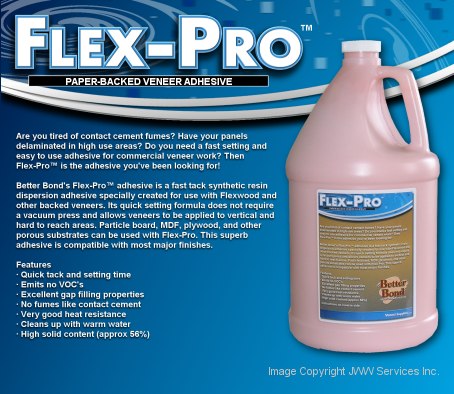
Are you tired of contact cement fumes? Have your panels delaminated in high use areas? Do you need a fast setting and easy to use adhesive for commercial veneer work? Flex-Pro might be the adhesive for which you've been searching!
Better Bond Flex-Pro is a fast-tack synthetic resin dispersion adhesive specially created for use with backed veneers and high pressure laminates. Unlike solvent-based contact cement, Flex-Pro is practically odorless, and the fumes are not dangerous. Its quick-setting water-based formula does not require a vacuum press and allows the application of veneer to vertical and hard-to-reach areas. No on-site pressing equipment is needed to apply this adhesive.
Particle board, MDF, plywood, and other porous substrates can be used with Flex-Pro. Compatible with most top-coatings, including solvent-based finishes.
Features
- Quick tack and setting times
- Superior bond strength ideal for commercial applications
- Unlike contact cement, Flex Pro allows a small amount of re-positioning
- Flex-Pro emits no VOC's and is non-polluting
- Excellent gap filling properties
- No fumes like solvent-based contact cement
- Thick consistency reduces dripping during application to vertical panels
- Very good heat resistance (up to 180° F)
- Good water resistance
- Non-flammable!
- Cleans up with warm water
- High solid content (approx 56%)
Shelf Life: 6 months
Coverage: 225 - 400 square feet per gallon (depending on application thickness/method)
Minimum Use Temperature: 55° F
Safety Information: Click here
Very Important Information about Freeze Protection See this page before ordering! |
Instructions
Use with paper-backed and two-ply veneers as well as high pressure laminates. Not for use with unbacked wood veneers. Always test the adhesive on scrap materials first.
Flex-Pro is only suitable for use on porous surfaces. Scuff the substrate with 80 grit sandpaper. The backing of a paper-backed veneer should also be scuff sanded. Use a glue roller to apply an even coat of adhesive to the substrate. A 4 to 7 mil spread rate is adequate. Do not apply Flex-Pro to the veneer. Allow 3 to 5 minutes of open time and apply the backed veneer. This time frame is dependent on the porosity of the substrate and ambient temperature and humidity. The glue should be wet when the veneer is placed onto the substrate. Set the veneer onto the substrate and wait 10 to 15 minutes before running the panel through a nip/pinch rolling machine. If a pinch roller is not available, a veneer scraper or a small block of softwood may be used to set the veneer.
Completed panels may be dead stacked for 1 hour to ensure adequate bonding. Allow 24 hours for the panel to fully cure before machining. Failure to follow these instructions may lead to bubbles forming on the veneer surface. If this issue arises, the bubbles can be removed by applying heat from a clothes iron set to a medium-high temperature. Place a cotton cloth between the iron and the veneer to prevent scorching.
Tips from Joe
I've used Flex-Pro on a few non-standard substrates and had success. Since there are no solvents in this fast-tack adhesive, I've been able to use it on some painted surfaces as long as the paint was intact. Past projects have included painted door and window jams as well as staircase stringers. Remember, this glue is used with paper backed veneers only. Flex-Pro is the same formula as conventional FSV glue or "flexible sheet veneer" adhesive. It's just less expensive. To get a perfect bond, you must follow the instructions carefully. I highly suggest doing a test panel on a scrap veneer first.
 The importance of applying this glue correctly cannot be overstated. Don't make the mistake of using a paint brush or paint roller to apply this adhesive. A dedicated glue roller is the recommended application tool. This suggestion is not a sales tactic! The glue roller we offer is unmistakably the right tool to apply this adhesive.
Questions & Answers
Where can I find a chart that shows all of the Better Bond veneer glue differences?
This downloadable adhesive chart shows all key points about each of the Better Bond veneer adhesives and may be helpful when choosing a glue for your next veneering project.
How do I apply Flex-Pro?
Get a glue roller... it's worth every penny. We have them!
What is the Flex-Pro coverage per gallon?
Coverage amounts vary depending on the thickness of the application. This is largely defined by the tool used to apply the adhesive. The factory-specified coverage amount is 400 square feet, but as I believe a range of 225 to 400 square feet is more likely based on what our customers are saying.
How many coats of Flex-Pro need to be applied to substrate and/or veneer?
Just one is needed unless the surface is very porous. If the glue dries up quickly or unevenly, then a second coat should be applied. Reduce the open time when this occurs.
Can I apply Flex-Pro to plastic surfaces such as laminates?
It may work for HPL, but I've never tried it and so far, no one has sent any feedback on it.
Can I use this adhesive in a vacuum press?
Yes, and it's been said that panels require just 5 to 7 minutes of press time.
What is "dead stacking"?
Dead stacking refers to placing completed panels under some weigh just to insure a perfect bond. It's not absolutely necessary, but if the panel was poorly bonded, the dead stacking will minimize (if not eliminate) any delamination.
Did I correctly read that one must wait 24 hours before flush-routing the glued veneer?
Generally, you need to wait until the glue fully hardens before machining it. The text book time is 24 hours, though it's probably much less.
How will Flex-Pro hold up under my finish?
There shouldn't be any problems if you have followed the instructions. I've used all sorts of finishes, and I've never had any issues unless it was related to me not following the Flex-Pro instructions. Water-based stains and top coats will create immediate problems if the bond is not made properly, so following the directions is critical.
Can Flex-Pro be used with a traditional veneer hammer?
The initial high-tack bond of this adhesive allows it to be used with paperbacked veneer in the tradition of veneer hammering however I still recommend a veneer scraper which applies more pressure than a veneer hammer.
Why is this adhesive pink?
When the original version of this product was developed many years ago, it was tinted pink to match the color of Wilsonart spray contact cement. This helped to reduce any shock when cabinet and furniture makers were first asked to test the product. Weird marketing trick, right?
How long should one wait before applying topcoats over a panel completed with Flex-Pro?
24 hours.
What does FSV stand for?
Flexible Sheet Veneer
Is Flex Pro FSV glue freeze/thaw stable?
This adhesive is not usable if it is allowed to freeze. Once frozen, it turns to a solid lump of very hard rubber.
Product Reviews
-
Flex Pro Review
Review by Richard Kimberly Heck
Rating:
I just wanted to second Joe's comment about using this glue on 'non-standard' substrates. I've just veneered the cabinets in my kitchen, which had previously been painted white. I stripped off the paint from a couple surfaces and also tried veneering without stripping. The only difference was that the edges of the veneer sometimes needed to be ironed down when I didn't strip the paint. That's easy to do, and I find I often need to 'touch up' this way anyway. So, in the end, I decided not to bother stripping the paint.
[Note from Joe: It is imperative that the surface is tested with scrap material first and then thoroughly evaluated for performance. I've had success with this adhesive over painted surfaces and so have others, but there are various formulations of paint (interior/exterior, flat, egg-shell, semi-gloss, etc). Some paints may not allow this adhesive to bond correctly so test, test, test!]
-
Hobbyist Uses in Off-Label Application
Review by Roger Rasmussen
Rating:
I used this in an arts/craft application where regular PVA had too much moisture content. This stuff works amazing. I pretty much made my own paper-backed material with it, with thin kraft paper and strips of basswood cut with a planer from 1/4" stock. I made a material to make 1/48 scale cedar shingles for model roofing. I could not have done it without this. Was recommended by a friend. Seems similar to canopy glue in some ways.
-
Really Impressed
Review by James Mitchell
Rating:
Hey Joe, I just wanted to let you know that I've been super impressed with the Flex-Pro adhesive. I built a coffee table with curved surfaces all around and wanted to use a Doug Fir veneer with 10 mil paper backing to reduce the visible paper line. Finding the right adhesive that would allow me to apply the veneer with a veneer hammer and light clamping was crucial, but I also needed to avoid the veneer creeping that I've seen happen with contact adhesive. Flex-Pro had both of those features and the result was stunning. One bonus I should mention is how a few bubbles popped up where I didn't do a great job of clamping the veneer flat, and this was easily fixed with a clothes iron in about 10 seconds. Really impressed.
-
Joe is Very Attentive to Detail
Review by Evan Cordes
Rating:
We've been buying this glue from various vendors for years. First time ordering from VeneerSupplies.com. It has the quality that it really doesn't like to freeze. As luck would have it, we unexpectedly ran out the coldest week in January. Right after we placed our order, Joe sent us an email that the freeze protection wouldn't be effective in those super cold temperatures, so he attentively waited until the weather warmed up a bit to ship our glue. Came in packed really well, and it wasn't frozen! Thanks, Joe.
-
Review from Harrison Township, Michigan
Review by John DeVos
Rating:
I did quite a bit of research about the proper adhesive for my application and this one was highly recommended by the experts. The price was better that other sites and Joe answered my questions very quickly. They also offered freeze resistant packaging for the product which I needed for delivery to Michigan in the dead of winter. My product was shipped literally within minutes of them receiving the order. Any veneer projects I have in the future, the materials will be bought here. Thanks for the great service!
-
You’ll Be Pleased
Review by Dwight H.
Rating:
Joe helped me select Flex-Pro for my first veneering project, restoring an old oak kitchen table with paper-backed 4x8 sheet veneer. Flex-Pro was selected for its "contact cement" type qualities since I don't have a vacuum press. The surface of the table was an old, deteriorated veneer with some major divots filled with epoxy wood filler and sanded smooth with 80 grit paper.
I followed instructions to the letter, including practicing on test panels. The glue was very easy to spread evenly with Joe's glue roller, and had no unpleasant odor. Tool clean up was a breeze. When placing the veneer panels down, it was easy to slide them around a bit for perfect positioning. Using a veneer scraper with more than two firm passes, I had good adhesion without any bubbles. After my test panels had cured, I noticed that the edges had some areas that would lift slightly with upward pressure on the veneer overhang. I may have not put as much pressure on the edges as needed to avoid breaking the veneer. However, since my project was veneering a pre-machined table top rather than making panels that would be later machined, I opted to clamp the edges when I veneered the actual table top. Result? Perfect! Even on areas where the non-porous epoxy repair extended all the way to the edges. Since this isn't a typical "instant adhesion" contact cement, it may be best with clamping in some applications. I was relieved to have perfect adhesion of veneer not only on the porous substrate, but even to the epoxy treated areas and all of the edges.
Customer service and support is first rate. My order arrived before expected and every item was just as described. This product is first rate, just make sure that you use sufficient pressure with your veneer scraper to get good contact and you’ll be pleased.
Shipping Discounts



Also Recommended


Your Wish List
 |
|
 |
|||||||||||||||||||||||||||||||||


All Content ©2026 VeneerSupplies.com™
Terms and Conditions | Privacy Policy | Contact Us