






Categories
- Raw Wood Veneer
- Paper-Backed Veneer
- Edge Banding
- Vacuum Press Items
- Veneering Supplies
Shop by
Veneer Species
Build Your Own Vacuum Press

Veneer Supplies Newsletter



How to Flatten Wood Veneer
Our guide to using veneer softener to flatten burls and more
Even the best veneers can have mild to moderate rippling. This is typically caused by areas where there is a high density of wood cells which, during changes in moisture content, expand and contract at a different rate than areas where the density of wood cells is less. This is especially true of crotch and burl veneers.
There's an old trick for determining whether you need to flatten a veneer before you work with it in a vacuum press. It's 20 cents more than a nickel's worth of free advice. You'll only need to do this trick once to learn when flattening is needed. After the first time, seeing and feeling the veneer will be enough to know if flattening is needed. Be aware that this technique does not apply to veneers that will be adhered with Heat Lock™ adhesive. For that type of glue and bonding technique, it is always best to completely flatten the veneer with Super-Soft 2™.
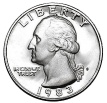 Get a quarter and place it on the veneer. Move it around the veneer and look for gaps between the veneer and the coin. If any place on the veneer shows more than 1/8" of gap under it, you'll probably need to flatten the veneer. Of course, this is just a rule of thumb. You will find that exceptionally brittle veneers need to be treated with a veneer softener and flattened regardless of the gap.
Additionally, veneers that are being seamed together (using a veneer saw and veneer tape) are much easier to cut and join when they are very flat.
Veneer Softener 101
We've tried several types of softening solutions.
Fabric softener - There will be a large handful of readers who will say that they have used fabric softener to make veneer pliable. We won't argue this because these folks are right. It will make veneer pliable, but it will also leave a residue that can catastrophically affect the bonding of the material to the substrate. It can also impact the absorption of some wood stains and finishes.
Water - Indeed water will have a small and short-lived effect on a veneer's flexibility. It will not condition the wood cells which is critical to getting the veneer flat without splitting. Additionally, if the water dries too fast, the veneer sheet can severely split and crack.
Homemade Softener - There is an antique veneer softener recipe of consisting of 3 parts water, 2 parts yellow glue, 1 part vegetable glycerin, and 1 part denatured alcohol. This combination will soften veneer, but it's sticky, messy, and hard to dry. It will also seal the wood cells which can have an effect on the wood's ability to accept a stain and finish. If you opt to use homemade veneer softener, you will find that glue content causes the veneer to stick to the absorbent paper. You can avoid this issue by placing a piece of fiberglass cloth between the veneer and the paper. Fiber glass cloth can be found at your local hardware store near the adhesive aisle.
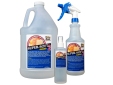 Super Soft 2™ Veneer Softener - Despite its cheesy name, SS2 is by far, the most effective and user-friendly veneer softener available. By temporarily plasticizing wood cells, veneers treated with Super-Soft 2 become easy to flatten and surprisingly flexible. Once dry this softener does not affect the gluing, staining, or clear-coating properties of the veneer.
Apply it by dipping, spraying, or brushing. No mixing is required.
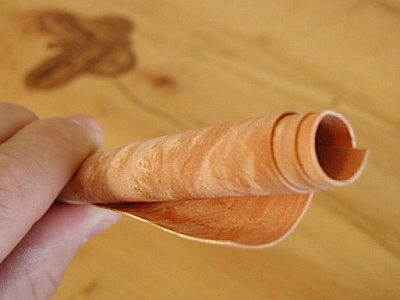 We took the picture shown on the right to give you an idea of how well Super-Soft 2 works. This image shows a madrone burl veneer that has been sprayed with veneer softener and then rolled around a pencil. There are no cracks or splits. You can probably imagine the many possibilities with complex veneering projects when it can be made this flexible.
Here is an interesting bit of information. If you get a drop of softener on your work bench and leave it there, the chemicals in SS2 will retain the water content, and it won't evaporate for several days!
Super Soft 2™ Application Instructions
- Saturate both sides of the veneer with softener by dipping, spraying, or brushing.
_ - Allow the veneers to stand until the surface is free of shiny, wet areas.
_ - Place veneer between two sheets of absorbent paper (paper towels, brown paper, or unprinted newspaper) and place it between two flat boards.
_ - Apply plenty of weight or clamping pressure to the top. You increase the success rate of the flattening process with each pound of weight that is added. Inadequate weight or pressure can allow the veneer to become more wavy. Some species, including but not limited to maple and bubinga, require a very, very large amount of clamping pressure which sometimes can only be achieved with a vacuum press.
_ - Leave the veneer under pressure for four to six hours. Then replace the absorbent sheets every 6 hours and apply the weight or pressure again until the veneer is completely dry. Keep as much pressure as possible on the veneer during the drying process.
_ - Determining when the softener has fully dried has a lot to do with your senses. If the veneer feels cool, looks dark, or smells a lot like the softener, then it is probably not fully dry. Do not use the veneer on a project until the softener has dried.

More Information
There is a full page of additional information about our veneer softener that you may find very helpful. Click here and click on the "Questions & Answers tab".
| Vacuum Press Helps Flatten Stubborn Veneers A quick tip for vacuum press owners |
|
Apply softener to the sheets and place them in vacuum bag with a top and bottom platen. Place absorbent paper on both sides of each veneer. Pull at least 18" Hg for an hour on the bag. This will make the veneer flat enough to go into a lesser strength flattening device such as the method described above. Be sure to put paper towels between everything. From there, change the paper every 6 hours until the veneer is dry or use the "speed drying" trick below. |
| Super-Soft Speed Drying Trick Based on an idea by Gene Young |
|
After applying Super-Soft to the veneer, use a clothes iron set on medium heat to dry and flatten the veneer at the same time. Do this in a well-ventilated area. It's best to put a cotton or flannel cloth between the veneer and the iron. Keep the iron moving continuously around on the veneer. When the veneer appears to be dry you can prep it for the veneer press. The effects of the softener are notably shorter with this trick so be certain to use the veneer as soon as possible. Otherwise, it may ripple again. Most of what will be evaporated into the air at temperatures above 212°F will be water. Super-Soft 2 has a very high boiling point, meaning no volatiles will be produced until over 350°F. Because it contains some water, it's possible that the steam from the water above 212°F will carry some of the softener with it. It's unlikely that the lower temperature will create any volatiles from the veneer softener, so it would be a small amount, if any. If some of the softener does get airborne in the steam, the chemical driven off is diethylene glycol monoethyl ether which, according to the MSDS, it is not expected to be an inhalation hazard. Both circulating and exhaust fans should always be used where volatiles are present. Alternate Method for Stubborn Veneers |
 |
|
 |
|||||||||||||||||||||||||||||||||


All Content ©2026 VeneerSupplies.com™
Terms and Conditions | Privacy Policy | Contact Us